The short answer
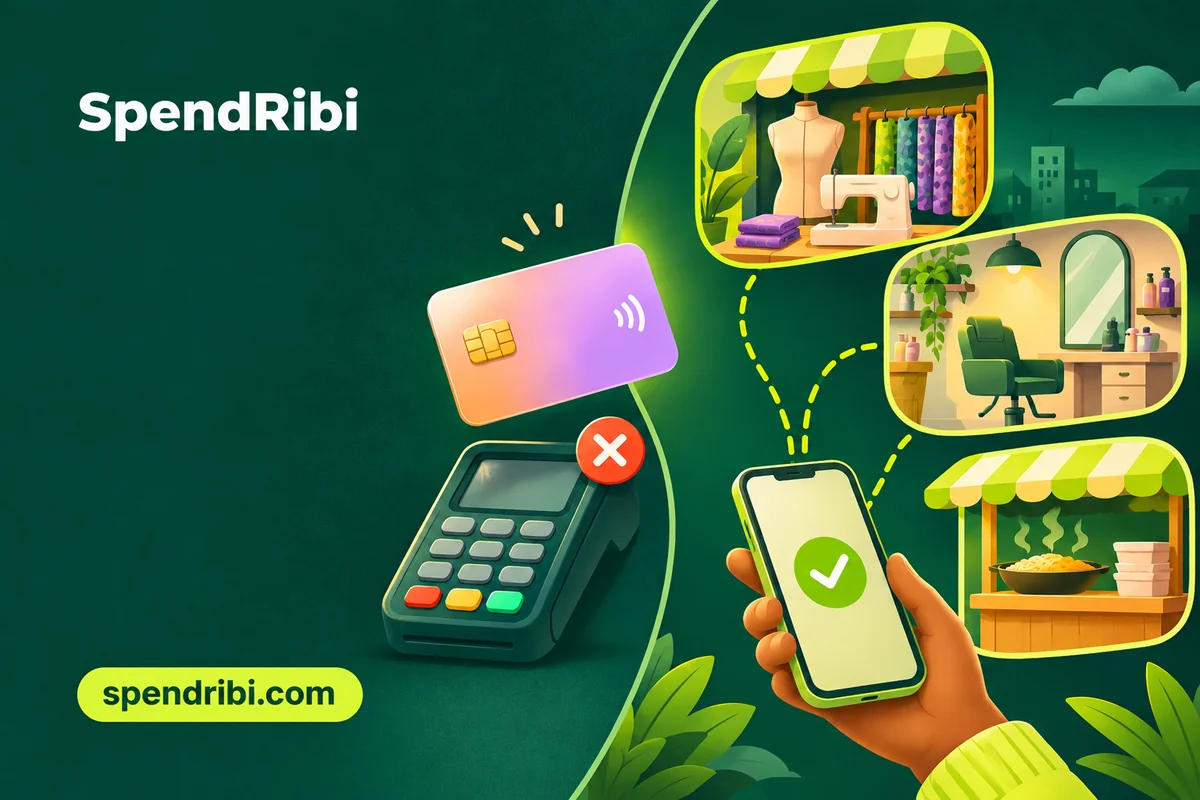
A crypto card turns your coins into a card payment, so it only works where a business takes cards. Across much of Africa, the salon, the tailor, the food spot and the phone repairer are paid by cash or bank transfer, so the card never gets a chance to work.
The alternative is to stop trying to pay at a till. You pay online for the thing itself, in crypto, and a business near you or your recipient delivers it. That is the model SpendRibi is built on.
How a crypto card actually works
A crypto card looks like a normal debit card. Behind it, a provider holds or converts your crypto, and when you tap or enter the card number, it sells enough of your balance to cover the payment in local currency. The merchant sees an ordinary card transaction and never touches crypto.
That design is clever, and for online shopping with global merchants it often works well. Subscriptions, flights, international shops and big supermarket chains are all comfortable places for a card. The trouble starts when you try to use it for everyday life in an African city.
Where crypto cards break
The first problem is acceptance. A card can only be used where there is a card terminal or an online checkout that takes card payments. In many African markets, a large share of small businesses do not take cards at all. They are paid by bank transfer, mobile money or cash.
The second problem is declines. Many crypto cards are issued in one country and used in another. Local payment systems, fraud filters and currency rules mean a card that works perfectly abroad can be declined at a pharmacy in Lagos or a restaurant in Accra. Ask anyone who has relied on a foreign card at a local till and you will hear the same story.
The third problem is cost. A card payment can stack several charges: the spread when your crypto is sold, a foreign exchange margin, a card fee, and sometimes a monthly or loading fee. Fee structures differ between providers, so check the full schedule before you load a card. On a small everyday purchase, those charges can add up to a noticeable slice of what you paid.
The fourth problem is support. When a card payment fails at a small shop, there is often no easy way to fix it on the spot. The merchant cannot help, the card provider is in another time zone, and you are left paying some other way.
The businesses cards cannot reach
Think about the people who actually make up daily life. The tailor who makes your wedding outfit. The barber you have visited for ten years. The laundry down the road. The woman who makes the best small chops in your area. Many of them have no card machine and no plans to get one.
None of these businesses is a bad business. Transfers and mobile money already work for them and their regular customers. A card terminal adds costs and settlement delays they do not need. So the gap is not that these businesses are behind. The gap is that crypto cards were designed around a payment habit that much of Africa never adopted at small scale.
What works instead: order-based spending
Order-based spending flips the problem. Instead of paying at a till, you choose what you want online and pay for it upfront in crypto. The business near you, or near the person you are sending it to, receives an order and delivers or books it. They are paid in their own currency, or in stablecoin if they prefer.
On SpendRibi this looks simple. You pick a city, then choose a brand reward, a dinner, a spa day or a service like tailoring or phone repair. You pay in USDC, USDT, BTC, ETH, SOL or another supported coin. A licensed partner converts the payment the moment you pay, so nobody is exposed to price swings. Then a vetted business near you or your recipient delivers, usually within 1 to 7 business days, or books a time.
The business never needs a card terminal or a crypto account. It just fulfils an order, which it already knows how to do.
A worked example
Say you hold 150 USDC and want a pair of trainers in Lagos.
With a crypto card, you would go to a store, hope it takes cards, hope your foreign-issued card is approved, and pay the spread and FX margin on top. If the payment fails, you are back to selling USDC for naira and transferring.
With order-based spending, you open the Adidas reward on SpendRibi, choose Lagos, pay for a reward of that value in USDC, and get a reward link. You pick the trainers you want, and a store near you delivers or you collect. You see the full price in crypto before you confirm, so there are no surprises at a till.
When a crypto card still makes sense
Crypto cards are not useless. They are a good fit for global online shopping, travel bookings, subscriptions and large chain stores that take cards. If most of your spending is with international merchants, a card can be the most convenient tool.
Order-based spending is the better fit when you want something from a local business, when you are buying for someone else in another city, or when you want an experience or a service rather than a product off a shelf. Many people will happily use both.
Read next: Spend crypto without cashing out, Crypto gift cards vs real-world rewards, Local services you can pay for with crypto.
Key takeaways
Crypto cards only work where cards are accepted, and much of everyday African commerce does not run on cards.
Declines, stacked fees and limited support make cards frustrating for local, everyday spending.
Order-based spending lets you pay upfront in crypto while a local business delivers, with no card terminal and no crypto handling on their side.
Use a card for global merchants and an order-based service for local products, experiences and services.
FAQ
Do I need a bank account to spend crypto this way? No. You pay directly from your crypto wallet. The business is paid in local currency by our licensed payment partner.
Does the business I buy from need to accept crypto? No. They receive an order and are paid in local money, or in stablecoin if they choose.
Can I send something to someone in another country? Yes. Every product can be sent as a gift by phone number or email to someone in any of our launch cities.
Which countries are covered? At launch: Nigeria, Ghana, Kenya, South Africa and Rwanda, with cities going live as supply is signed.
When can I start? SpendRibi launches publicly in Q1 2027. Join the waitlist for early access.
Join the waitlist
If you are tired of cards that decline and cash-outs that eat into your money, join the SpendRibi waitlist and spend your crypto on real things, wherever you or your people are.